
A community-built clinic in Wajir is hitting its targets for mothers and babies. We followed the shilling from the county budget to the delivery room and found three places where it leaks away – and a community already keeping score.
UNICEF Kenya | Bajeti Hub | Northern Regional Budget Hub | 27 October 2026
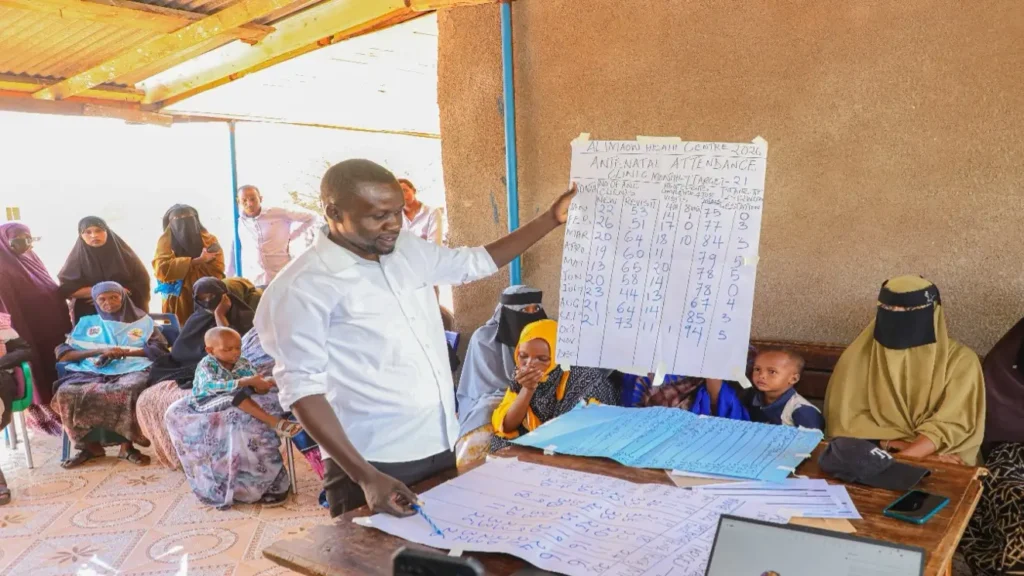
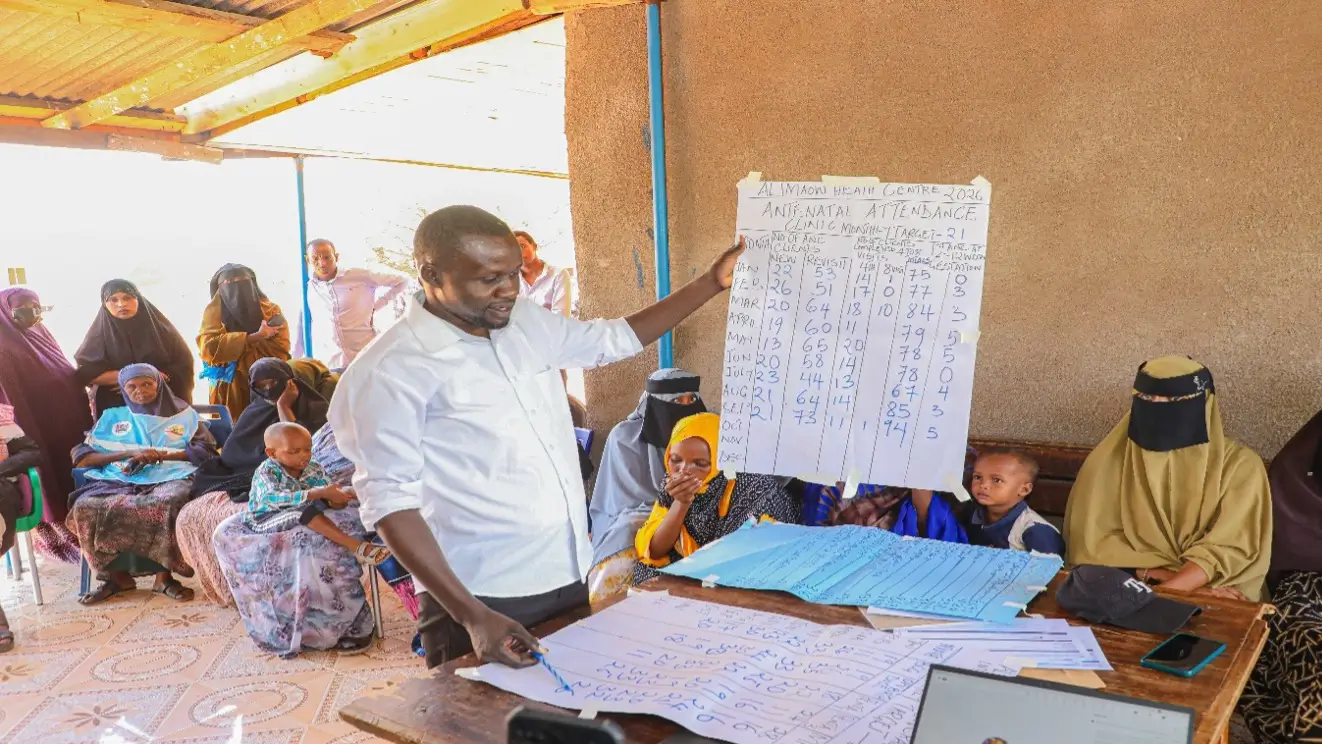
The numbers on the wall: Alimaow’s 2026 antenatal attendance, against a monthly target of 21, is shared openly with the community during the scorecard session.
Ask who built Alimaow Health Centre, and you will not be pointed to a budget line. You will be pointed to the community. Residents pooled their own money to start it. The Senior Chief, who has served the area for 23 years and chairs the facility committee, still champions it, alongside his long fight against child marriage.
Today it is a Level 3 facility working towards Level 4. On Tuesday 27th of October, a joint team from UNICEF Kenya, Bajeti Hub and the Wajir County Civil Society Consortium went there with one question: when public money is meant for children, how much of it reaches the frontline?
The clinic is delivering. The financing system behind it is not keeping up.
Follow the shilling: three leaks between the budget and the baby
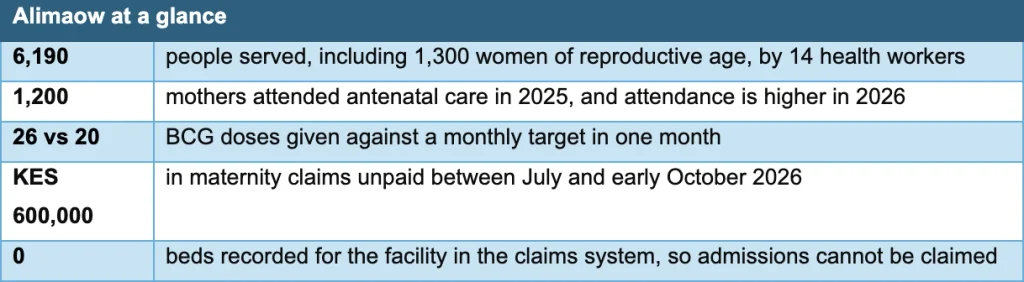
Start with what is working. Some months, antenatal visits approach 100. The facility usually meets its monthly immunization target of 20 children. With about 248 deliveries expected each year, it aims for 21 skilled deliveries a month. In a county where distance, drought and scattered settlements make every visit costly, these are real gains.
Now follow the money that is supposed to pay for that work. Between the county budget, the Social Health Authority and the facility’s own account, it leaks in three places.
Leak 1: Free maternity care that nobody pays for
Maternity services at Level 2 and 3 facilities are meant to be free. Alimaow delivers the babies. But staff told us that claims are paid only if the mother’s insurance premium is fully paid up. Between July and early October 2026, about KES 600,000 in maternity claims went unpaid.
That is roughly 60 normal deliveries, close to three months of the facility’s maternity income. The mothers were served and the babies were born. The bill is still open.
Leak 2: A fingerprint decides whether a visit counts
Primary health care is paid per visit, and every visit must be verified by fingerprint. Many clients cannot be captured. On one day, about ten antenatal mothers were seen and not a single claim was generated. Stricter paperwork since July has cut the number of claims submitted.
The registers show the work, but the payments do not. A facility doing more ends up earning less, leaving less in its own account for drugs, repairs and emergencies.
Leak 3: The last mile has no budget line
Outreach is how a missed vaccination is caught up and how a mother who skipped antenatal care is traced. At Alimaow, it was funded by a partner until the last disbursement in FY 2025/26. The County Health Management Team says the county has set aside funds to sustain partner-funded programmes in primary care facilities. But until that money is disbursed, and part of it ring-fenced for outreach, the furthest villages have no support at all.
Outreach is how a missed vaccination is caught up and how a mother who skipped antenatal care is traced. At Alimaow, it was funded by a partner until the last disbursement in FY 2025/26. According to the County Health Management Team, the County Government of Wajir has set aside some resources to sustain the partner-funded programmes within the primary care facilities. However, No county money has replaced it. Theuntil it’s disbursed and part of it ring-fenced for outreaches, the furthest villages now have no support at all.
Supplies leak too. BCG, a newborn’s first protection against tuberculosis, has been out of stock on and off throughout 2026. Vaccine and syringes often do not arrive together, and a health worker cannot vaccinate a baby with half a supply chain.
Free for the mother. Unpaid for the clinic. A risk for every child who comes next.
The community is not waiting – it is keeping score
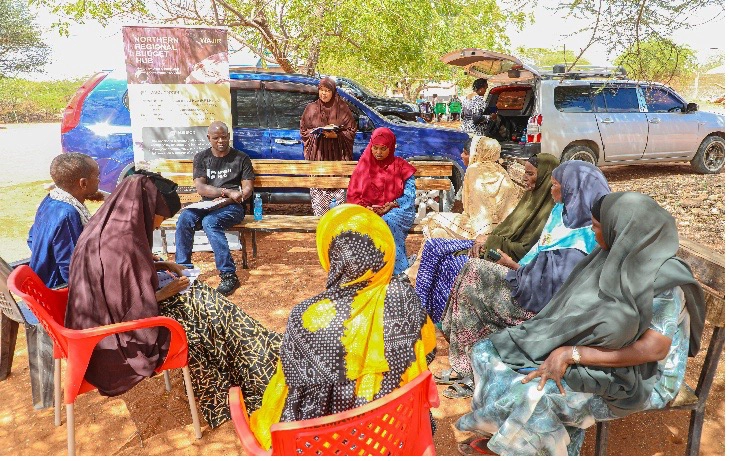
Alimaow was chosen for a community scorecard because local champions flagged its service gaps. Mothers, other users including persons with disabilities, and facility committee members each rate the facility, and health workers score themselves. The groups then sit at one table to compare results. The findings go to the community, civil society and the county to agree a joint action plan. This is public participation that does not end at a public hearing. It ends with commitments that someone has to follow up.
Keeping score under the trees: community members rate their health facility in a scorecard focus group at Alimaow.
Next door in Garissa, we have already seen where that can lead. On 15 May 2026, 14 women met for a budget café under a tree in Sankuri. A month later, their ward memo reached the County Assembly asking for maternity beds, incubators, washrooms and maintenance funds. Within three weeks, seven maternity beds arrived. The Assembly Clerk opened a logbook for citizen memos, and the women’s budget cell grew from 12 to 20 members. Evidence from the ward, plus direct follow-up, moved money faster than the formal budget cycle.
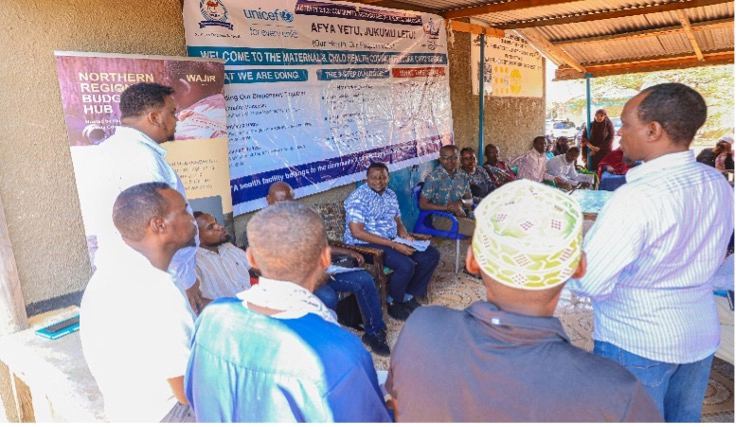
Wajir is building the same muscle. Women are moving to the center of budget work, and the county has promised to support a proposed allocation for women. Budget Champions are being trained to restore a presence on the ground. Civil society is also holding itself to the same standard: as one consortium member put it, organizations that ask government for accountability must first account for the resources they receive.
“Afya Yetu, Jukumu Letu” – Our Health, Our Responsibility. Community members, health workers and partners meet at Alimaow to agree what needs fixing.
Four fixes before Wajir drafts its next budget
- Pay for the work already done. Settle the outstanding maternity claims and correct facilities bed record so admissions can be claimed.
- Count every visit. Fix verification so that no mother is lost to a fingerprint scanner.
- Give the last mile its own line. Fund outreach and vaccine logistics in the county budget, with BCG and syringes delivered together, rather than relying on partner grants.
- Put the scorecard on the budget table. Compare facility registers with claims paid and take the gap to the county health team and the Social Health Authority.
What happens next: from the clinic to the county budget
The scorecard continues. Scoring and self-evaluation run through November, followed by joint action plans with the facility and county health teams. Between December 2026 and February 2027, the findings go to the county Health Sector Working Group and into the County Fiscal Strategy Paper. That is where Alimaow’s evidence can become next year’s budget lines.
This visit is UNICEF’s first direct look at Bajeti Hub’s work in Wajir. It sets a baseline. The community built the clinic, health workers filled it, and mothers trusted it. Now the budget has to keep its side of the bargain.


